
One waypoint, and it gets there.
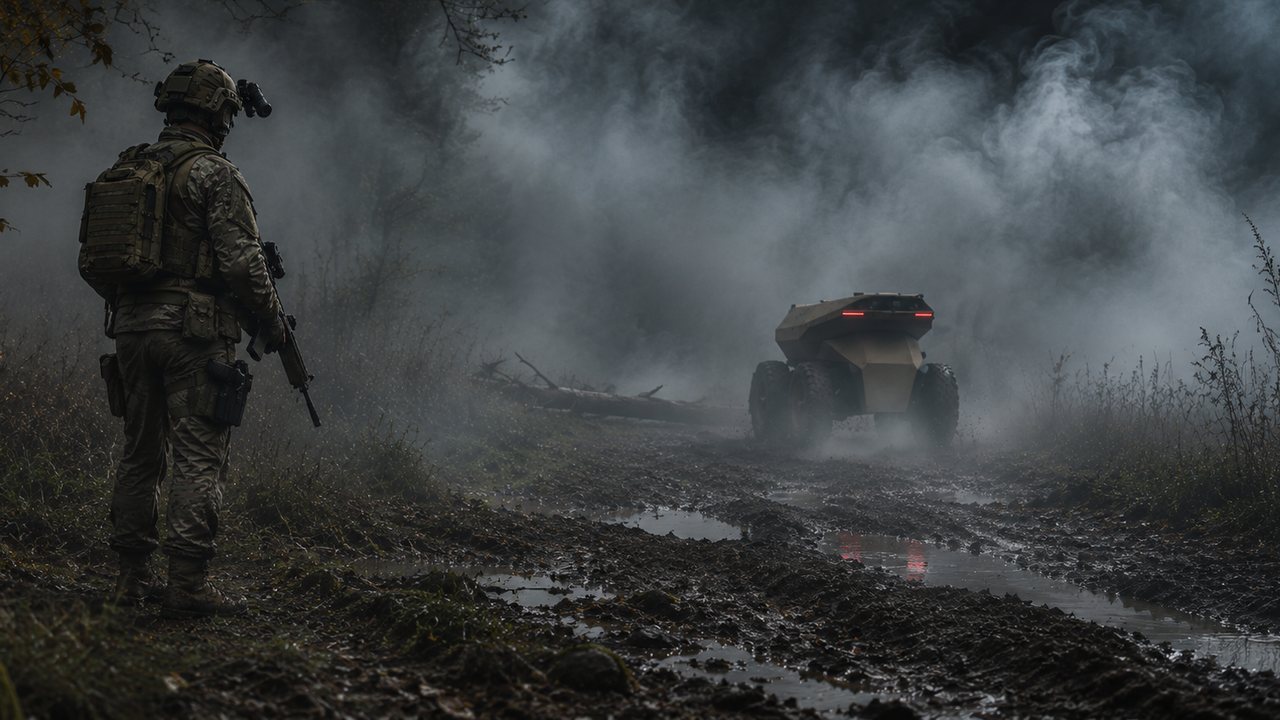
Just one waypoint. Point to where you need eyes, a load or an effect. Terra AI plans its own way and drives by sight through smoke, dust, tall grass, ditches and dark, with or without GPS, handling whatever is in the way. It's fully covert, with no emissions. Mission command for a machine: no elaborate waypoint mission to plan around obstacles.
Risk to equipment, not risk to force.
Tall grass and brush, after rain
The grass is taller than the robot; the model finds a way through it. Right: camera and what it marks drivable. Left: the 3-D map it built, green drivable, red not.
Night, on one thermal camera, lights off
Twelve waypoints under trees in the dark. No lidar, no illumination, nothing emitted.
On Army ground, with Army engineers
The Army Ground Vehicle Systems Center's own course, the robot's own eyes. Unedited.
Same autonomy. Your vehicle, or ours.
Terra AI is a learned model, a few commercial cameras and one small computer. The vehicle is whichever one the job calls for.
 Illustration
On your vehicleAutoDrive Lite, the kit
One sealed module and a harness on any drive-by-wire chassis: the small robot a program already builds, the side-by-side, the tracked carrier. The two sensors it replaces, a multi-plane lidar and a tactical-grade inertial unit, cost more than the whole kit. The platform maker or the depot fits it. Terra AI does the rest.
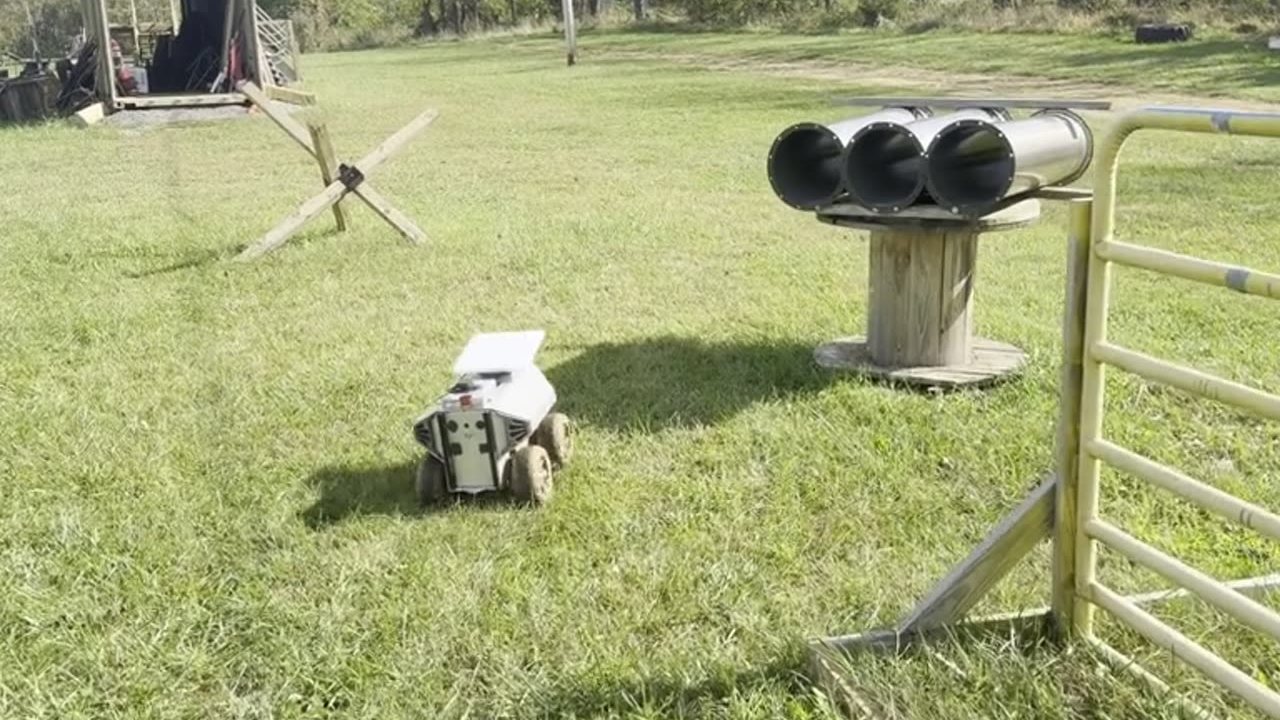 15 October 2026, West Virginia
On oursTerraScout, the robot
The vehicle in every film on this page. 20 to 40 kg, a one-soldier lift, four hours and twenty miles on a charge, a payload rail. It exists now, so a unit can field it in numbers this year and learn what it does on its own ground. Built on a robot family with 160 built and more than 100 fielded.
Same model, same software, same release. Every vehicle that drives improves all of them. Choose the chassis; the autonomy is identical.
What you get, and why only this stack
| What you get | How | Why only this stack |
|---|---|---|
| Affordable and attritable. Issue them in numbers; lose one and keep going. | Cameras and one small computer. No lidar, no tactical inertial unit. | Built for eight years under a farmer's budget; the incumbents' architecture cannot get to the price. |
| One kit, any vehicle. The small robot, the side-by-side, the tracked carrier, the same brain. | One shared perception model; the vehicle profile is a setting. | Trained on 160 vehicles of three sizes; nothing retrained per chassis. |
| Adapts to the ground and learns from it. Grass, snow, mud, water and obstacles judged like a driver; a morning failure fixed by afternoon. | Every mile drives the training; the vehicle labels its own data by traction. | 110 terabytes and 20,000 missions nobody else has, growing with every fleet that runs it. |
| Sees through dust, smoke, fog and the dark. Knows a cloud from a wall. Night on thermal. Covert: nothing emitted, nothing to jam. | Camera-first perception with inferred depth; thermal as a second eye. | A point cloud cannot tell dust from a wall; a camera that understands can. |
| Drives through tall grass and brush. Vegetation is not a wall; it goes through what a lidar kit stops at. | The model knows grass from ground from obstacle, a difference it learned in crop rows. | Eight seasons in corn and under palm; tall grass after rain was on the 15 October course. |
| Gets there without GPS. One waypoint, not a route. Maps as it goes. | Drives by sight; a fix is a convenience, not a dependency. | Eight seasons under tree canopy, where there has never been a fix. |
You give it the objective. It works out the how.
It builds its own picture of the ground.
Give it the satellite image, the map, the MCOO if one exists. It builds its own mobility picture for the vehicle it is on, plans from that, and corrects the picture as it drives.
It sees the ground, and it stops for people.
One camera and a model that learned what drivable looks like over eight seasons and more than a hundred fielded robots. Grass, mud, water, a log, a ditch: judged like a driver. A person in the way is a stop, every time.
It knows a cloud from a wall, and grass from a wall.
Lidar sees dust, smoke, fog and tall grass as solid. A camera that understands the scene sees through them to the ground. At night the same brain runs on a thermal camera, with nothing emitting and nothing to jam.
GPS is a convenience, not a dependency.
It drives by sight and holds its course when the signal is jammed or gone. It came from under tree canopy, where there has never been a fix.
The pull is there before the first order.
The Jeep of autonomy. The 1941 Willys Jeep was not the Army's most capable vehicle. It was the one the Army ran on: it worked, it was affordable, it got the job done, and it could be issued everywhere and fixed with a wrench. Terra AI is that layer for autonomy: the same on every vehicle, priced to be issued in numbers, deployable now, fixed by the unit on its own ground. The Army made this move once already, in the air, when a few dollars of MEMS sensing and a GPS chip replaced a fiber-optic gyro costing tens of thousands. Ground autonomy is at the same point.
Put it on your vehicle
In four weeks: driven on a course it had never seen, driven at night on a thermal camera, run on Army ground at Detroit Arsenal. The company comparison, the prices and the operating plan are available under NDA.
The fastest way to judge it is to put it on your ground. We bring the team and the robot, or the kit for the vehicle you already build.